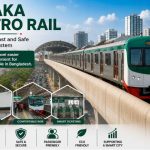

Dhaka Metro Rail is one of Bangladesh’s major transportation routes. It provides great convenience for the people of Bangladesh in their daily travel.
The capital of Bangladesh is one of the most densely populated cities in the world. Every day, millions of people travel across the city for work, education, business, and various personal needs.
However, due to severe traffic congestion, commuters have long suffered while moving around Dhaka. People often spend hours stuck on the roads and fail to reach their workplaces, educational institutions, or destinations on time.
To address this long-standing problem, the Government of Bangladesh introduced the Dhaka Metro Rail system, an efficient and modern transportation solution that has greatly benefited the public.
The metro rail is one of the most significant infrastructure projects in Bangladesh. It incorporates advanced technologies and modern facilities, making transportation in the capital faster, safer, and more comfortable.
The Dhaka Metro Rail is not only a means of transportation; it also represents Bangladesh’s progress toward becoming a modern and smart nation. It has helped showcase Bangladesh as a developing and technologically advanced country on the global stage.
Benefits of Dhaka Metro Rail
As the population of Dhaka continues to grow, traffic congestion and road accidents have become increasingly common. Thousands of vehicles operate on the city’s roads every day, resulting in massive traffic jams. A journey that should take only ten minutes often takes an hour or more.
To solve this issue, Bangladesh implemented the metro rail project with the cooperation of the Japan International Cooperation Agency (JICA). Japan provided both financial assistance and advanced technical expertise, which played a vital role in the successful completion of the project.
History of the Metro Rail Project
The idea of introducing a metro rail system in Dhaka is not new. Discussions about building a rapid transit system to reduce traffic congestion had been ongoing for many years.
The project officially began in 2012. Afterward, planning, land acquisition, environmental assessments, and construction activities gradually moved forward.
Despite facing numerous technical and administrative challenges, the first section of the metro rail was eventually inaugurated, marking a new chapter in Bangladesh’s transportation sector.
Today, the metro rail has become one of the most preferred modes of transportation in Dhaka. The route currently extends from Uttara to Motijheel, with plans to expand further toward Kamalapur in the future.
The line is over 20 kilometers long and has been constructed entirely as an elevated railway system.
Metro Rail Stations
The stations of the Dhaka Metro Rail include:
- Uttara North
- Uttara Center
- Uttara South
- Pallabi
- Mirpur 11
- Mirpur 10
- Kazipara
- Shewrapara
- Agargaon
- Bijoy Sarani
- Farmgate
- Karwan Bazar
- Shahbagh
- Dhaka University
- Secretariat
- Motijheel
These stations help transport passengers efficiently from one location to another. Each station is equipped with elevators, escalators, and various modern facilities designed to ensure convenience and safety for passengers.
Advanced Technology in the Metro Rail
The metro rail system operates entirely on electricity. As a result, it reduces environmental pollution and saves fuel.
Advanced signaling systems are used to manage train operations, significantly reducing the risk of accidents and ensuring high levels of safety. The trains also follow strict schedules, ensuring timely service.
Each train is equipped with:
- Air-conditioning systems
- Digital information displays
- CCTV cameras
- Emergency communication systems
- Automatic safety doors
These facilities provide passengers with a safe, comfortable, and reliable travel experience, enabling them to reach their destinations on time and without worry.
Ticketing System
Dhaka Metro Rail has introduced a modern ticketing system that allows passengers to purchase tickets conveniently and efficiently.
Occasional travelers can buy single-journey tickets for individual trips.
For regular passengers, special smart cards are available. These cards can be recharged and used repeatedly, eliminating the need to purchase tickets every day. Automated entry and exit gates help save time and improve passenger service.
Passenger Experience
High-quality passenger service is one of the defining features of the metro rail system. This commitment to service excellence has contributed significantly to its popularity.
The trains and stations are kept clean and well-maintained through regular maintenance programs.
Special facilities have also been provided for persons with disabilities, senior citizens, and women.
Metro stations offer:
- Elevators
- Escalators
- Directional signboards
- Security personnel
- Information centers
These services make traveling easier, safer, and more comfortable for everyone.
Role in Reducing Traffic Congestion
Traffic congestion has long been one of Dhaka’s most serious problems. Since the launch of the metro rail, the situation has improved considerably.
Residents can now travel to their destinations more quickly and conveniently. As a result, pressure on road transportation has decreased significantly.
Previously, traveling from Uttara to Motijheel could take two to three hours. With the metro rail, passengers can complete the same journey in a much shorter time.
Economic Benefits
The Dhaka Metro Rail contributes significantly to the national economy by saving time and increasing productivity.
Every day, countless working hours are saved because people can travel efficiently to their workplaces. This allows employees and businesses to operate more effectively and contribute more to the economy.
Commercial activities around metro stations have also increased, creating new economic opportunities and strengthening local businesses.
Furthermore, the metro rail has enhanced Bangladesh’s image internationally, attracting interest from foreign investors who view the country as increasingly modern and developed.
Contribution to Environmental Protection
Since the metro rail operates entirely on electricity, it plays an important role in protecting the environment.
Its environmental benefits include:
- Reduced air pollution
- Lower carbon emissions
- Reduced noise pollution
- Decreased fuel consumption
As a result, the metro rail supports the development of a greener and more sustainable urban environment.
Social Impact of the Metro Rail
The metro rail has made life easier for people from all walks of life, including students, office workers, businesspeople, and ordinary commuters.
Women, in particular, benefit from a safer and more secure transportation system.
Many important locations in Dhaka are now more accessible, including Shahbagh, Dhaka University, the National Parliament area, and other key destinations.
This improved accessibility has also made the city more convenient for both domestic and international tourists.
Metro Rail Management and Operations
The operation and management of the metro rail system are handled by Dhaka Mass Transit Company Limited (DMTCL).
The organization is responsible for:
- Operations management
- Maintenance
- Safety and security
- Passenger services
A team of trained professionals ensures the efficient functioning of the entire system.
Passenger safety is maintained through:
- CCTV surveillance
- Security personnel
- Emergency alarms
- Fire protection systems
- Automatic door control systems
These measures help passengers feel secure throughout their journey.
Challenges and Future Plans
The implementation of the metro rail project faced numerous challenges. Constructing a large-scale infrastructure project in a densely populated city like Dhaka was not easy.
Rising construction costs and various logistical difficulties also affected the project.
Despite these obstacles, the challenges were successfully overcome.
One metro line alone is not sufficient for a city as large as Dhaka. Therefore, the government has undertaken plans to develop multiple MRT lines.
- Future plans include:
- Launching new metro rail routes
- Connecting more areas of the city
- Increasing passenger capacity
- Developing an integrated public transportation network
Once these initiatives are fully implemented, Dhaka’s transportation system will undergo a major transformation.
Metro Rail and the Smart City Vision
In modern cities around the world, efficient public transportation is an essential component of urban development.
Dhaka Metro Rail is playing a crucial role in transforming Dhaka into a smart city. Through digital ticketing, modern communication systems, and environmentally friendly technologies, it is laying the foundation for a modern urban transportation network.
Conclusion
Dhaka Metro Rail is a shining symbol of Bangladesh’s development. It is not merely a transportation project but a representation of the nation’s progress and modernization.
The metro rail has played a significant role in addressing Dhaka’s long-standing traffic congestion problem. It has improved mobility, enhanced safety, and increased convenience for millions of people.
Today, the system is operating successfully, and additional metro rail lines are planned for the future. As Bangladesh continues to move forward, the metro rail will remain a key part of building a sustainable, efficient, and modern urban environment for future generations.